Lighting & Ambience
Bedroom Lighting Layers, Explained
The three lighting layers every bedroom needs - ambient, task, and accent - with lumen baselines for each and an order to build them in.
By Mara Bennett · Published February 13, 2026 · Updated February 27, 2026

A single bright ceiling fixture is the most common lighting setup in a bedroom, and the one that does the least for the room. It flattens every surface, throws hard shadows under your own chin when you read in bed, and gives you only two states: harshly on and completely off. The fix is not a bigger fixture. It is splitting light into three layers - ambient, task, and accent - and letting each one do a narrower job well. I lay every bedroom project out this way, in the same order, and the order matters as much as the fixtures.
Why one ceiling light flattens a room
When all the light comes from one point above you, the room gets brightness without shape. Walls wash out, corners go dark by contrast, and the ceiling reads brighter than everything under it, which is the opposite of how a restful room feels. There is also a practical problem: a central fixture is far from the bed, so any close work - reading, folding laundry, finding a dropped earring - happens in your own shadow.
Layering solves this by giving light a direction and a purpose. Once the three layers exist, you stop thinking about “the light” as one thing. You use different layers at different hours, and the room changes tone without you repositioning anything.
Layer one: ambient light
Ambient light is the base layer, the one that lets you move through the room without bumping anything. It should be soft, spread out, and come from more than one point. In a bedroom I prefer two medium sources on opposite sides of the room - a pair of lamps, or a lamp plus a wall fixture - over one strong source in the middle. The spacing matters more than the output: two gentler pools of light overlap gently and leave no dead corners.
Ambient light should also be dimmable if you can manage it. This is the layer you dim first in the evening and it carries most of the room’s mood, so a dimmer on this layer pays off every single night. If you want fixture-level ideas for this layer, my floor lamp picks cover the standing options that work well beside a bed.
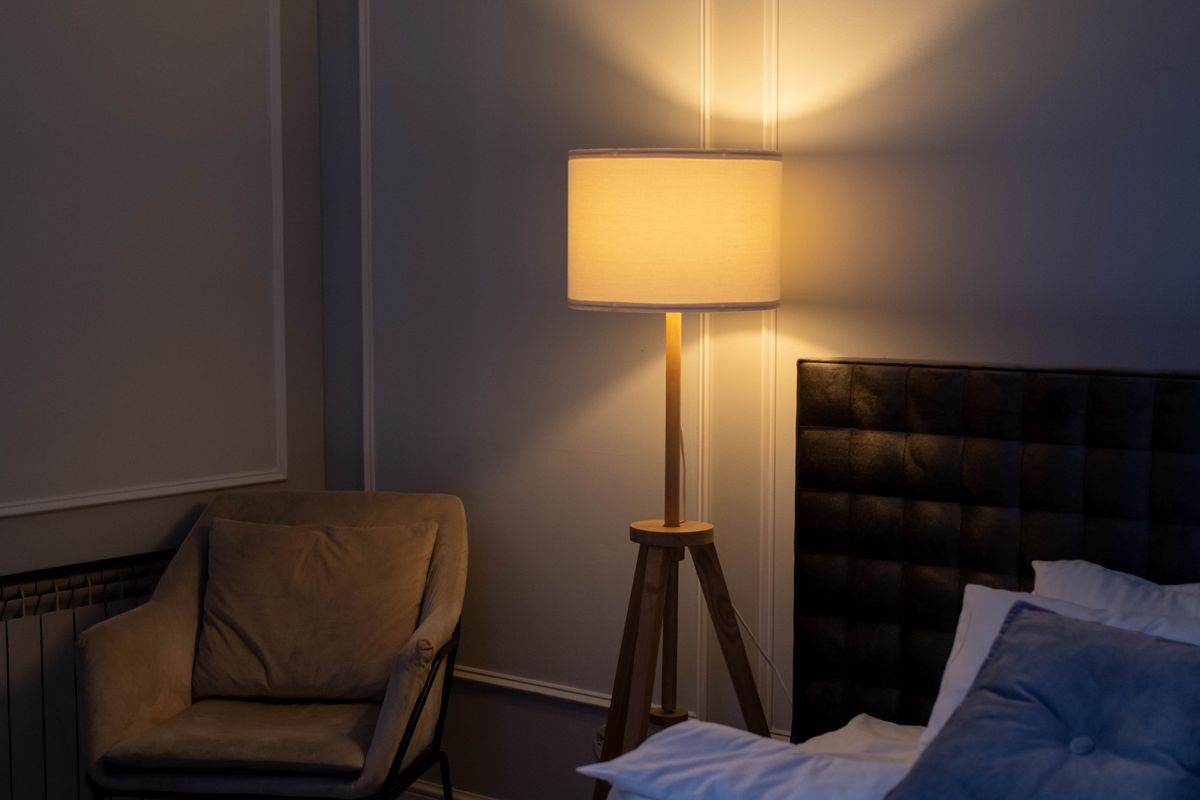
Layer two: task light
Task light is aimed and bright, and in a bedroom it has exactly three jobs: reading in bed, dressing at the wardrobe, and anything you do at a desk or vanity. What distinguishes task light is direction. The bulb sits closer to the work, so it can be physically smaller and still deliver more usable light than the ceiling fixture ever could.
A reading lamp belongs beside the bed, at or slightly above shoulder height when you sit up, so light falls on the page and not into the eyes of whoever sleeps next to you. A swing-arm wall sconce does this job beautifully and frees the nightstand surface - my sconce picks include several that mount without wiring. At the wardrobe, task light means a light near or facing the closet opening so you are not judging colors in shadow.
For output, a task lamp in the 200-to-450-lumen range covers reading comfortably. If you think in old wattages, ENERGY STAR’s bulb guidance puts 450 lumens at the brightness of an old 40-watt bulb, and 800 lumens at a 60-watt - a bedside lamp rarely needs the latter.
Layer three: accent light
Accent light is the layer people skip, and skipping it is why layered rooms still sometimes feel unfinished. Accent light is low and warm and marks the edges of the room: a small lamp on the dresser, a candle-style sconce on a far wall, a picture light. Its job is not brightness. Its job is to keep the corners of the room alive after the main lights go down, so the room reads as calm rather than as a bright island in the dark.
Accent fixtures can be tiny - 200 lumens or less is plenty. What they need is warmth. Anything cooler than the rest of the room will read as a bright spot instead of a glow, which is why I always pick accent bulbs from the warm end of the scale before choosing fixtures. If the color side of that decision is new to you, the kelvin temperature guide walks through which warmth suits which job.
A lumen baseline for each layer
You do not need to calculate anything to layer light correctly. A few reference points from ENERGY STAR’s brightness chart are enough to shop by:
| Layer | What it does | Lumen target per source |
|---|---|---|
| Ambient | Soft overall fill, spread across two points | Around 800 lumens - the old 60-watt bulb |
| Task | Aimed light for reading and dressing | 200 to 450 lumens - the old 25-to-40-watt range |
| Accent | Low glow at the edges of the room | 200 lumens or less |
Two ambient sources of 800 lumens each will light most bedrooms generously; in a small room, one 800-lumen source plus one at 450 may be all you need. The reason lumens and not watts is the right currency: with LED bulbs the wattage tells you almost nothing about brightness, and ENERGY STAR has been making exactly this point for years - brightness lives in the lumen number printed on the box.
Dimming holds the layers together
Layers are a system, and the dimmer is what lets the system shift gears. The evening pattern in almost every bedroom I work on goes like this: ambient drops to half first, task light carries on for reading, accent light stays on longest. Dimming beats switching because the room moves gradually - your eyes never jump from bright to dark.
If you are wiring nothing new, dimmable bulbs with a plug-in dimmer, or lamps with built-in three-way switches, get you most of the way. Check dimmable compatibility on the bulb package, because not every LED tolerates a dimmer and the wrong pairing causes flicker.
Building the layers in order, on a budget
You do not buy all three layers in one trip, and you should not. The order I use in every project:
- Ambient first. One good lamp on the side of the room farthest from the bed. This is the biggest gap in most bedrooms and the cheapest to fix.
- Task second. A bedside reading lamp with a bulb in the 450-lumen range. This is the layer you will use most hours of the day.
- Accent last. A small warm light on a dresser or shelf, added once the first two feel settled.
Buying in this order also spreads the cost. The first two layers fix ninety percent of what a single ceiling light gets wrong; the accent layer is what turns a corrected room into a calm one.
Frequently asked questions
- How many lumens does a bedroom need?
- For ambient light, one or two bulbs around the 800-lumen mark - the brightness of an old 60-watt bulb - usually covers a bedroom, spread across two fixtures rather than concentrated in one. Task lamps add 200 to 450 lumens each, directed where you read.
- What are the three layers of bedroom lighting?
- Ambient light is the soft overall glow, task light is aimed brightness for reading or dressing, and accent light is low-level glow that softens the edges of the room. Most bedrooms fail because they rely on ambient alone.
- Should bedroom lamps match in brightness?
- They should sit in the same family, but not be identical. Two bedside lamps at 450 lumens each flanking a dimmer ambient source gives you balance without the flatness of one bright ceiling fixture.